News

Expedition cruising is in the middle of a serious sustainability push. We're talking hybrid propulsion, hydrogen power, solar sails, biofuels, AI-assisted navigation. The pace in which it's moving is faster than at any point in the sector's history.
Here is what is happening in mid-2026.
Fuels are doing most of the heavy lifting, for now
Liquefied Natural Gas (LNG) remains the workhorse alternative fuel in the cruise industry, cutting carbon emissions by up to 25% compared with traditional marine fuel and reducing sulphur emissions to near zero. Green methanol and renewable biodiesel are gaining ground, and several new builds are being designed to be fuel-flexible so they can switch as supply scales up.
Hydrogen is the ambitious end of the spectrum. Viking Libra launches in late 2026, with sister ship Viking Astrea following in 2027. They will be the world's first hydrogen-powered cruise ships, running on proton exchange membrane (PEM) fuel cells that produce up to six megawatts of power for both propulsion and onboard electricity. Zero emissions, in theory. These are classic cruise ships, but with the potential to be applied to expedition vessels. We are watching closely to see how it works in practice.
Hurtigruten's climate-neutral first
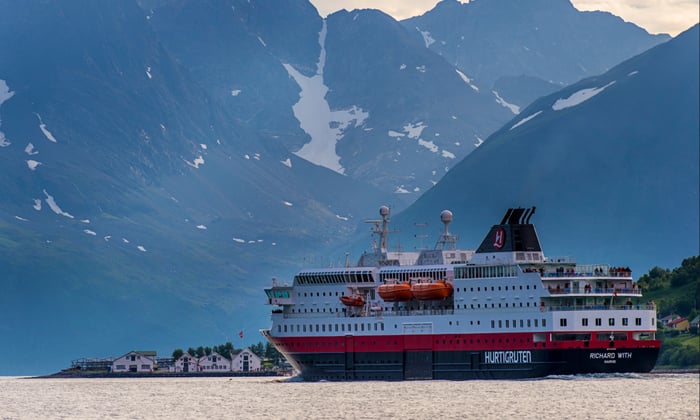
In October 2025, Hurtigruten ran what it called the first climate-neutral cruise, sailing the Richard With on a 4,000-kilometre round trip from Bergen to Kirkenes. The voyage used advanced hydro-treated vegetable oil (a biofuel) and connected to shore power wherever ports allowed, in partnership with the research body Sintef and others in the Norwegian maritime industry.
Since 2022, Hurtigruten has invested €100 million in fleet upgrades aimed at cutting emissions and expanding biofuel use. The October 2025 voyage was the proof point. The bigger question is how to scale a one-off climate-neutral sailing into a normal operating standard, and that is the work that comes next.
Ponant pushing the boundaries
Ponant aims to sail a decarbonised ship by 2030, and its approach is among the most interesting in the sector. Rather than betting on a single technology, they are working on a multi-energy strategy that combines several solutions on one platform. The line is prioritising research and development over short-term commercial returns, which is unusual at this scale.
Ponant was named the most environmentally friendly cruise line by Germany's Nature and Biodiversity Conservation Union (NABU) in 2020, and is the first international cruise line to join the Green Marine certification programme. None of that is window dressing. The company has built a credible track record over many years, and we trust the direction of travel.
Captain Arctic: the solar-sail expedition yacht
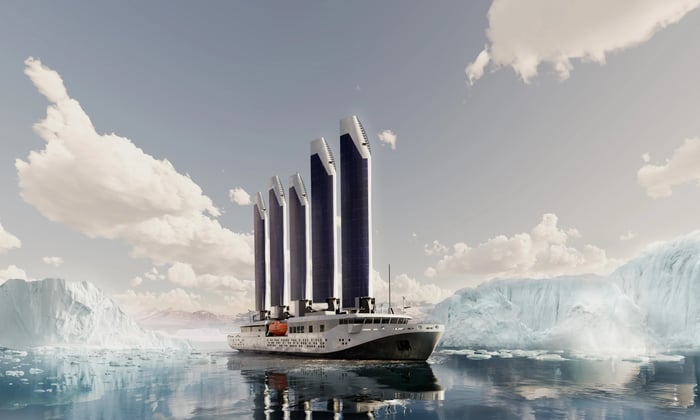
Captain Arctic, a 70 metre sailing yacht from the young French line, will start operating in November 2026 with itineraries through the icy fjords of Norway, Svalbard and Greenland.
The headline numbers are eye-catching. Five rigid, solar-patented sails as the primary power source, supported by 2,000 square metres of solar panels, two propeller shafts that double as hydro turbines, reverse osmosis water generation, a pellet boiler running on recycled wood waste and a reinforced stainless steel bow with an ice-strengthened hull. Selar claims a 90% reduction in carbon emissions compared to a traditional yacht of equivalent size.
Capacity is 36 guests across 19 cabins, with a one-to-one crew ratio including specialist guides. Interiors are mid-century modern by French architect Joséphine Fossey. There is an outdoor spa with a Norwegian cold bath, a 1920s-style bar and an onboard science lab for polar research. Captain Arctic will be the first yacht equipped to collect plastic waste in the regions it visits.
The yacht was co-founded by French-Swedish explorer Sophie Galvagnon, the world's youngest female Arctic captain at 26, who left commercial shipping after realising her career was harming the polar regions she loved. Charter pricing starts at €590,000 per week with Pelorus Yachting. The debut "Dancing With Orcas" expedition off Tromsø is already sold out.
Battery and hybrid technology are becoming the new normal
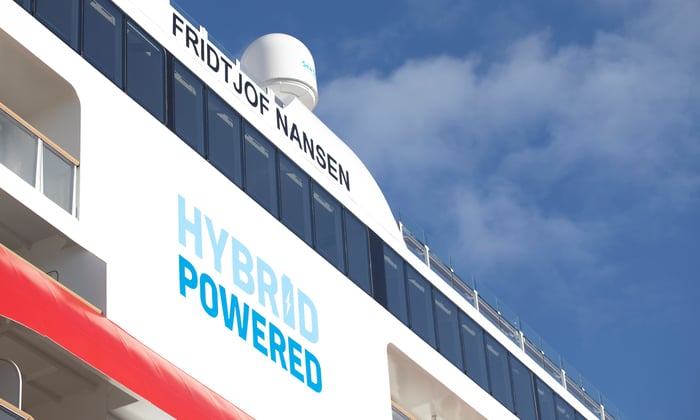
Batteries have moved from novelty to standard kit. HX Expeditions runs hybrid ships across its purpose-built fleet, pairing batteries with conventional fuel to cut consumption and emissions, and the line is also expanding shore-side renewable power in ports like Reykjavík. Norwegian operator Havila Voyages has outfitted its fleet with large-capacity batteries that can power vessels for several hours at a time, which is particularly useful in sensitive regions like Norway's fjords.
Norway's regulations are now driving the pace. From 1 January 2026, smaller vessels with a gross tonnage under 10,000 have been required to have hybrid propulsion and shore power connections to access the fjords. By 2032, non-zero-emission ships will be banned from the fjords entirely.
AI navigation: Aurora's Douglas Mawson
Not every sustainability story is about fuel. AE Expeditions deployed an AI-powered navigation system on its new 154-passenger Douglas Mawson for the 2025-26 Antarctica season. The system, built in partnership with Australian climate technology company CounterCurrent, uses onboard sensors to capture real-time wind, wave and ocean current data from one of the most data-poor regions in the world.
The data feeds into global climate and weather models, which improves forecasting accuracy and helps the wider industry plan safer, lower-emission routes. Aurora's sustainability manager, Sasha Buch, described it as filling critical data gaps in the Southern Ocean. We think it is a smart use of the polar tourism footprint. Rather than just minimising harm, the operation is generating something useful for the science community in the process.
Oceanwide is ordering eco-sail ships for the end of the decade
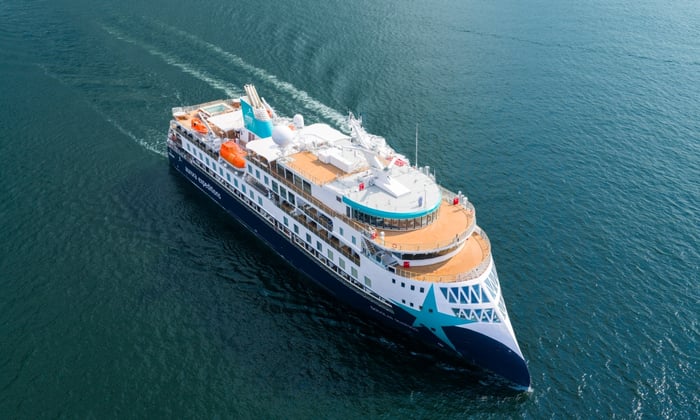
Further down the timeline, Oceanwide Expeditions signed a letter of intent in March 2026 for two new 146-passenger eco-sail vessels, the first launching in 2029 and the second in 2030. The ships will use hybrid sail propulsion to reduce fuel consumption and emissions and are an iteration of the existing Hondius-class design, with upgrades to both operations and guest experience.
More news is expected in early 2027 and we will share more as the design details emerge.
What the regulatory landscape looks like
A few things to keep in view. The International Maritime Organization's 2025 standards take effect in 2027 and will enforce deeper greenhouse gas cuts across the industry. The IMO's longer-term target is net zero by 2050. The European Union's Emissions Trading System and FuelEU Maritime initiative are making fossil fuel dependence progressively more expensive. Destinations like Norway and the Galápagos are also setting strict limits on emissions and passenger numbers.
The result is steady pressure from all sides, and the operators investing now are the ones best placed to keep sailing the most sensitive regions when the rules tighten further.

Meet the Author

Find a cruise
Sustainable Cruises
HX Expeditions
Grand Greenland – Mythical Lands of the North
From Reykjavik to Reykjavik
3 Jul - 19 Jul 2026 (16 Nights)
From £9,501 per guest
HX Expeditions
Grand Greenland – Mythical Lands of the North
From Reykjavik to Reykjavik
17 Jul - 2 Aug 2026 (16 Nights)
From £10,010 per guest

HX Expeditions
Alaska and British Columbia – Inside Passage, Bears and Aleutian Islands (Northbound)
From Vancouver to Seattle
25 Jul - 13 Aug 2026 (19 Nights)
From £10,018 per guest

Ponant Explorations
The Geographic North Pole
From Longyearbyen to Longyearbyen
27 Jul - 11 Aug 2026 (15 Nights)
From £40,446 per guest