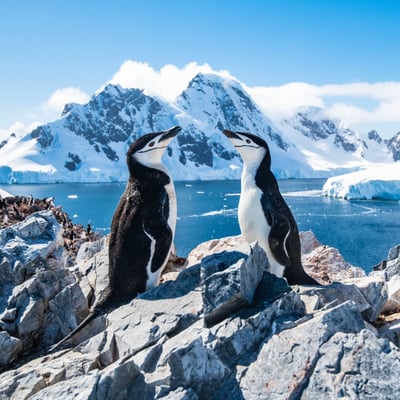
South Georgia and the Falklands sit between Patagonia and Antarctica, offering wildlife on a scale that surpasses even the Peninsula. King penguin colonies stretch across beaches in their hundreds of thousands. Elephant seals sprawl on black sand. Shackleton's grave marks the end of one of history's greatest survival stories. These are islands worth the detour.
South Georgia & Falklands Expedition Cruises

Find a cruise
Our top picks
Seabourn Cruises
59-Day Labrador Coast, Caribbean, South America & Scotia Arc
From Reykjavik to Ushuaia
20 Sep - 19 Nov 2026 (60 Nights)
From £28,813 per guest
Seabourn Cruises
45-Day Caribbean, South America & Scotia Arc Expedition
From Halifax to Buenos Aires
5 Oct - 19 Nov 2026 (45 Nights)
From £21,997 per guest

Seabourn Cruises
37-Day From The Caribbean To The Antarctic
From Bridgetown to Buenos Aires
13 Oct - 23 Nov 2026 (41 Nights)
From £18,897 per guest
AE Expeditions
Falklands, South Georgia & Antarctic Peninsula
From Ushuaia to Ushuaia
24 Oct - 14 Nov 2026 (21 Nights)
From £22,380 per guest
Our Insight
Highlights of a South Georgia & Falkland Islands expedition
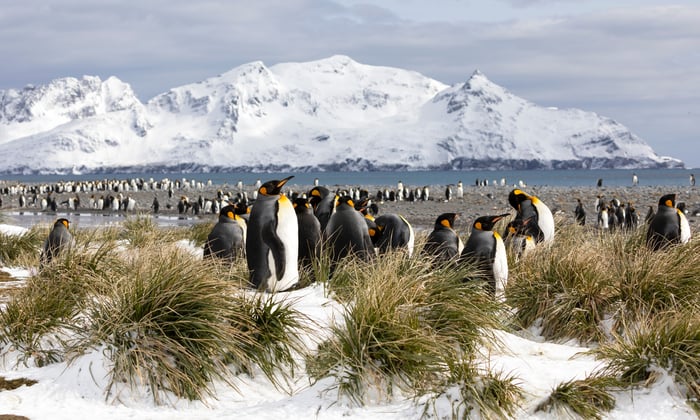
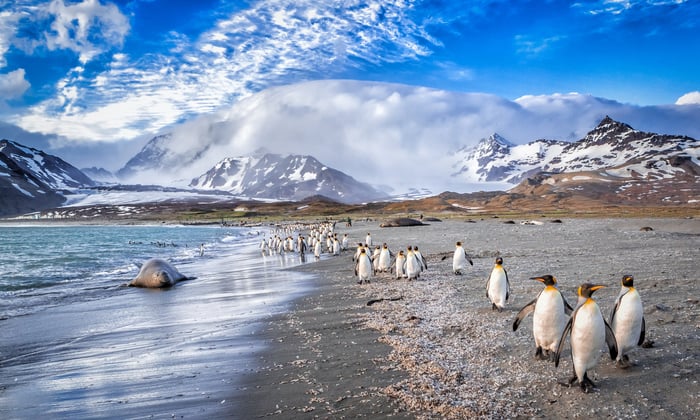
South Georgia delivers wildlife density you cannot prepare for. At St Andrews Bay, 300,000 king penguins crowd the beach, calling over each other in waves of sound that carry across the water. Elephant seals shift their weight in the shallows. Fur seals bark from the tussock grass. The smell hits first, then the noise, then the realisation that this many animals in one place feels biblical. Gold Harbour and Fortuna Bay offer similar scenes, each bay ringed by glaciers that calve into the sea with cracks like gunfire.
The whaling stations stand empty now. Grytviken's rusted machinery leans into the wind, flensing platforms open to the sky, blubber cookers silent since the 1960s. Shackleton is buried here, his grave facing the mountains he crossed to reach help after the Endurance sank. The museum is small and thorough. Outside, Antarctic fur seals sleep on old iron.
The Falklands feel different. Human-scaled. Stanley has red post boxes, stone churches and pubs that could sit on a Scottish island. The Historic Dockyard Museum documents the 1982 conflict with photographs, letters and objects that carry weight without ceremony. Outside the capital, farms spread across windswept hills. Rockhopper penguins gather on cliffs at New Island and West Point Island, jumping through surf that would flatten most birds. Black-browed albatross nest beside them, elegant and unbothered. The Falklands give you people, history and a sense of ordinary life unfolding at the edge of the world.
The expedition difference in South Georgia & the Falklands
These islands are rarely visited alone. Most itineraries include them as part of a longer Antarctica expedition, adding a week to the standard Peninsula voyage. The crossing from the Falklands to South Georgia takes 2 days, from South Georgia to the Antarctic Peninsula another 2. The seas can be rough but the ships are built to handle it, but the Southern Ocean makes no allowances for comfort.
Landings in South Georgia require flexibility. This is because the weather changes fast, like the wind that picks up without warning. The expedition team scouts sites daily, adjusting plans based on swell, visibility and wildlife activity. You might spend 3 hours ashore at one site and skip another entirely because the conditions turned. This is normal and makes every landing feel earned.
The group sizes stay small. Zodiacs shuttle people from ship to shore in rotations, usually 15 to 20 people at a time. Once ashore, you have to move carefully because fur seals are territorial during breeding season and penguins need space. But don't worry the expedition staff brief you before every landing, set boundaries and keep watch. South Georgia and the Falklands are not managed wilderness. They are working ecosystems where humans are guests.
South Georgia & Falkland Islands expedition itineraries
- Most voyages run 18-23 nights, departing from Ushuaia and combining the Falklands, South Georgia and the Antarctic Peninsula in a single journey. A typical route allows 2 days in the Falklands, 4 to 5 days in South Georgia and 6 to 7 days on the Peninsula. Some itineraries reverse the order, visiting the Peninsula first before heading east to the islands.
- A handful of expeditions focus solely on the Falklands and South Georgia without continuing to Antarctica. These are rare and typically run at the edges of the season, in late October or early November, when elephant seals are most active and penguin colonies are establishing. The shorter duration appeals to travellers who have already visited Antarctica or who want to maximise time in the islands rather than on the Peninsula.
- Transoceanic voyages occasionally include South Georgia as part of a crossing from Ushuaia to Cape Town or vice versa. These trips add even more remote islands like Tristan da Cunha, extending the voyage to 30-40 nights.
Expedition cruise lines sailing South Georgia & the Falkland Islands
Most expedition cruise lines that operate in Antarctica also offer itineraries that include South Georgia and the Falkland Islands. Silversea, Scenic, Ponant, Hapag-Lloyd Cruises, National Geographic-Lindblad Expeditions and AE Expeditions all operate select Antarctica voyages that visit either South Georgia or the Falkland Islands, or both.
Voyages that focus solely on the islands, without including Antarctica, are harder to come by but there are a couple. Seabourn offers an expedition exploring the Falkland Islands and the Atlantic Coast of South America. Quark Expeditions is another operator running purely South Georgia and Falkland Islands expeditions, allowing you to explore deeper in the islands without the time commitment of a full Antarctica voyage.
For current availability and recommendations, speak to us or explore our full Antarctica expedition collection.
The best time to visit South Georgia & the Falkland Islands
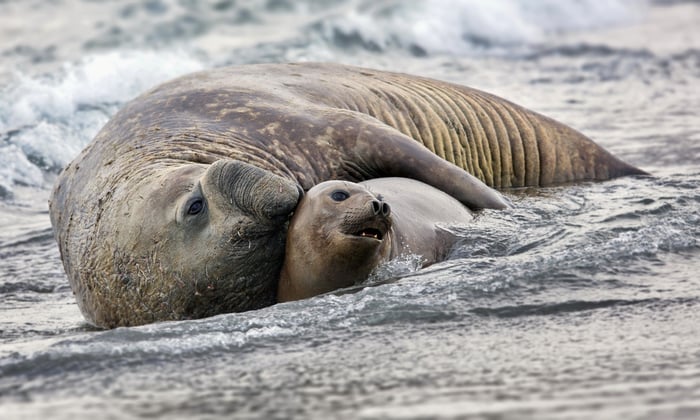
- November marks the start of the season. Elephant seals are territorial and aggressive, battling for beach space. King penguins are courting. Snow still covers the higher ground.
- By December, penguin chicks have hatched and fur seal pups arrive by the thousands.
- January and February bring peak wildlife activity. Beaches are crowded with life. Chicks are growing fast, demanding food from exhausted parents who shuttle between colony and sea.
- March signals the end of season. Weather turns colder, animals begin to disperse and ships move on to other regions.
The season is short, concentrated and entirely dictated by Antarctic summer. If you want to visit South Georgia and the Falklands, your window runs November to March with the best conditions landing somewhere between December and February.
Travel tips and FAQs for South Georgia & Falkland Islands expeditions
Should I add South Georgia to my Antarctica cruise?
If you have the time and budget, yes. South Georgia offers wildlife experiences that surpass even the Antarctic Peninsula. King penguin colonies alone justify the detour. The extra week adds cost and sea days, but most people who skip it wish they had gone.
How rough is the crossing to South Georgia?
The Southern Ocean between South Georgia and the Falklands or the Antarctic Peninsula can be challenging, with swells that rival the Drake Passage. Ships handle these conditions well, but if you struggle with seasickness, come prepared. The crossings are part of reaching islands this remote.
What is the Shackleton connection in South Georgia?
After the Endurance sank, Shackleton and five crew members sailed 800 miles in an open boat from Elephant Island to South Georgia, then crossed the island's unmapped interior to reach the whaling station at Stromness. Shackleton died on a later expedition and is buried at Grytviken. His grave faces the mountains he crossed.
Will I see king penguins in South Georgia?
Yes. South Georgia hosts over 100,000 breeding pairs of king penguins across several sites. St Andrews Bay is the largest colony, with around 300,000 individuals visible from the beach. Landings depend on weather and sea conditions, but king penguins are a guaranteed highlight of any South Georgia voyage.
What wildlife can I expect in the Falkland Islands?
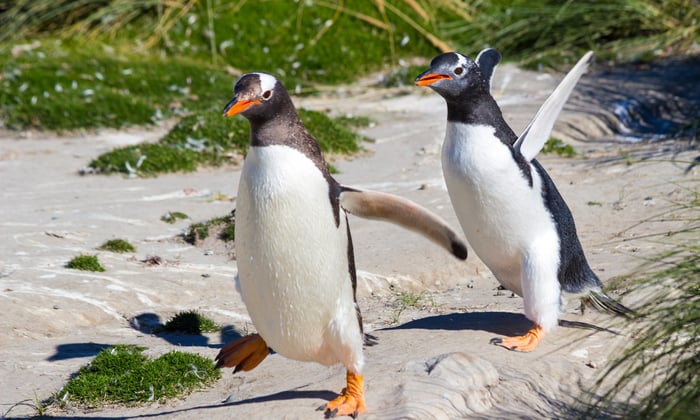
The Falklands are home to rockhopper penguins, Magellanic penguins, black-browed albatross, southern sea lions and large colonies of seabirds. The islands offer a different wildlife experience than South Georgia, with more human presence and easier walking conditions. Stanley provides insight into island life and Falklands War history.
Do I need special fitness for landings in South Georgia?
Basic mobility is required for Zodiac transfers and walking on uneven terrain. Some sites involve beach landings with loose stones or tussock grass. Conditions can be wet, windy and cold. You do not need to be an athlete, but reasonable fitness and proper waterproof gear help. Expedition staff tailor landings to weather and guest ability.
Are there places to stay ashore in South Georgia or the Falklands?
South Georgia has no tourist infrastructure. There is a small research station at King Edward Point and the abandoned whaling station at Grytviken, but no accommodation. The Falklands have guesthouses and hotels in Stanley, but most expedition cruises remain ship-based throughout. The only way to visit South Georgia is by expedition ship.
How long does a South Georgia and Falklands expedition take?
Most voyages that include both island groups run 18-23 nights, departing from Ushuaia. This typically includes the Falklands, South Georgia and the Antarctic Peninsula in a single itinerary. Islands-only expeditions are shorter, usually 10-14 nights, but these are rare and operate at the edges of the season.
collections
You may also like

Antarctic Peninsula & Weddell Sea
A trip to Antarctica, the seventh continent, is like travelling to another world – an extraordinary experience of a lifetime that you will never forget.

Svalbard & the North Pole
Travel further north than 99.99% of the population to Spitsbergen and the Svalbard archipelago on a Svalbard expedition, where you really will feel as if you have gone to another planet – a magical experience.

Greenland & Northwest Passage
Breathtaking scenery, great wildlife and a fascinating history are the key features of Greenland, with access to the fabled Northwest Passage on exciting cruises to Greenland.